5 Mistakes to Avoid When Applying for a Debt Consolidation Loan: In 2026, with credit card interest rates hitting record highs—averaging over 22%—debt consolidation loans are a popular tool for financial relief. However, if not handled correctly, they can lead to a “double debt” trap that leaves you in a worse position than where you started.
Here are the five most critical mistakes to avoid when applying for a debt consolidation loan in 2026.
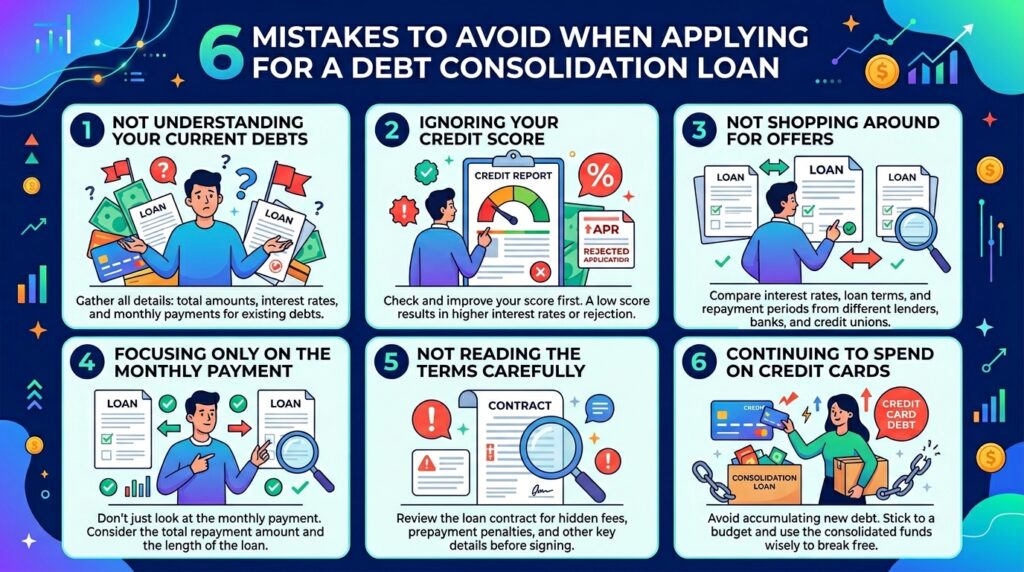
1. Focusing Only on the Monthly Payment (and Ignoring the Term)
Lenders in 2026 often market loans by showing you a significantly lower monthly payment. While this helps your cash flow, it often comes at the cost of a stretched repayment term.
- The Risk: If you consolidate a credit card you would have paid off in 2 years into a 5-year personal loan, you may end up paying thousands more in total interest, even if the interest rate is lower.
- The Fix: Always calculate the Total Cost of Interest over the life of the loan. Aim for the shortest repayment term your budget can realistically handle.
2. Failing to Address the “Root Cause” of the Debt
A debt consolidation loan is a “financial band-aid.” It moves your debt but doesn’t delete it.
- The Risk: Many borrowers feel a false sense of freedom once their credit card balances hit zero. Without a new budget, they begin using those cards again for daily expenses, effectively doubling their debt (the new loan + new credit card balances).
- The Fix: Before applying, track your spending for 30 days. If you don’t have a surplus at the end of the month, the loan will only be a temporary fix. Freeze your cards (literally or figuratively) the moment they are paid off.
3. Ignoring Hidden “Front-End” Fees
In 2026, as lenders face tighter regulations, many have shifted their profit models toward origination fees.
- The Risk: Some lenders charge between 1% and 6% just to process the loan. If you take out a $20,000 loan with a 5% fee, $1,000 is taken out before you even see the money. You still owe interest on that $1,000.
- The Fix: Compare loans based on the APR (Annual Percentage Rate), not just the interest rate. The APR includes these fees and gives you a true apples-to-apples comparison.
4. Consolidating Low-Interest Debt Into the Loan
It’s tempting to throw every bill you have into one easy payment, but this can be a math error.
- The Risk: If you have an older personal loan or a student loan at 4% or 5%, and you roll it into a new consolidation loan at 10%, you are intentionally making your debt more expensive.
- The Fix: Only consolidate debts that have an interest rate higher than the new loan’s APR. Keep low-interest debts separate.
5. Applying Before “Polishing” Your Credit Score
In the current 2026 lending environment, the difference between “Fair” and “Good” credit can mean a 5% to 8% difference in your interest rate.
- The Risk: Applying for multiple loans in a short window creates “hard inquiries” that drop your score further, potentially locking you into a high-rate loan.
- The Fix: Use a “soft pull” pre-qualification tool first to see your estimated rate. If it’s too high, spend 2–3 months lowering your Credit Utilization Ratio or using tools like Experian Boost before submitting a formal application.
Summary Checklist
| Mistake | 2026 Impact | How to Avoid |
| Longer Terms | Higher total interest paid | Compare “Total Cost,” not just “Monthly Payment” |
| Old Habits | Double the debt within 12 months | Create a budget before the loan is funded |
| High Fees | Instant 5% loss of loan value | Shop for “No-Origination-Fee” lenders |
| Mixing Rates | Paying more for cheap debt | Keep loans with < 6% APR separate |
| Blind Apps | Hard inquiries with high rates | Use “Soft-Pull” pre-approval tools first |