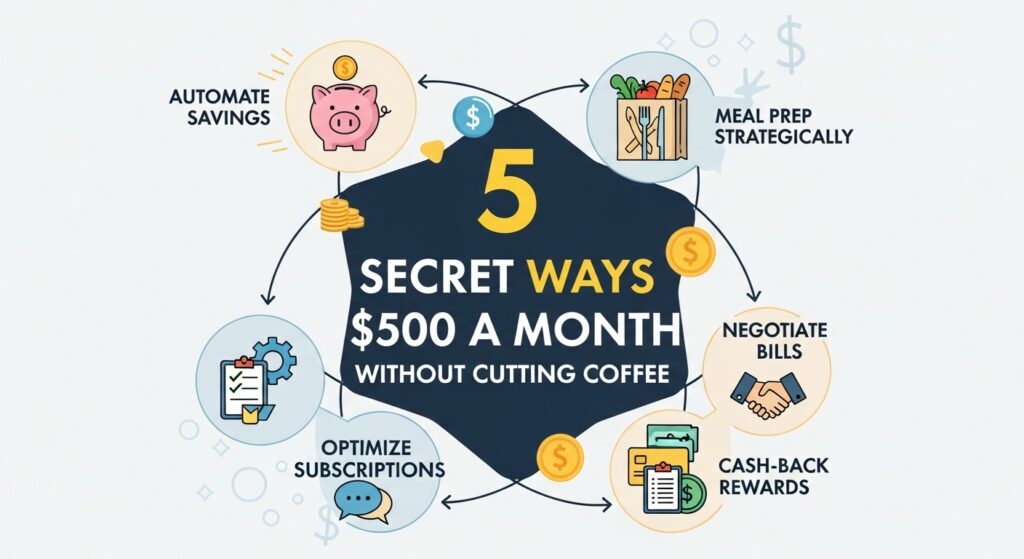
5 Secret Ways to Save $500 a Month Without Cutting Coffee: The conventional wisdom about personal finance often suggests that cutting small expenses like daily coffee is the key to building wealth. However, this approach misses the bigger picture. The truth is that you can save $500 a month—or even more—without sacrificing the daily rituals that bring you joy. The real secret lies in identifying and eliminating the hidden expenses that drain your budget without providing meaningful value. This comprehensive guide reveals five proven strategies that can help you save $500 monthly while keeping your beloved coffee habit intact.
Understanding the $500 Challenge: Why Most People Fail
Before diving into the solutions, it’s important to understand why most people struggle to save $500 monthly. The average American household spends over $6,000 per month on essential and discretionary expenses. To save $500 monthly, you need to identify inefficiencies and redundancies that represent approximately 8% of your budget.
The Problem with Conventional Advice:
Most financial advice focuses on cutting small daily expenses—the “latte factor.” However, this approach often fails because:
- Psychological Resistance: Cutting daily pleasures creates resentment and unsustainability
- Minimal Impact: Saving $5 per day on coffee only yields $150 monthly, far short of the $500 goal
- Ignores Root Causes: The real budget drains are typically hidden in subscriptions, insurance, and service fees
The solution isn’t to cut what you love; it’s to eliminate what you don’t notice you’re paying for.

Secret #1: Audit and Eliminate Subscription Creep ($100-$150/Month Savings)
The first secret to saving $500 monthly is identifying and eliminating subscription creep—the accumulation of monthly subscriptions that you’ve forgotten about or no longer use.
The Subscription Explosion:
The average American household now has 9-12 active subscriptions, totaling $200-$300 monthly. These include streaming services, software subscriptions, fitness apps, meal kits, and premium memberships. Many of these subscriptions are forgotten or underutilized.
How to Audit Your Subscriptions:
- Review Your Credit Card Statements: Go back three months and identify all recurring charges
- Check Your App Subscriptions: On iOS, go to Settings > [Your Name] > Subscriptions. On Android, go to Google Play > Account > Subscriptions
- List Everything: Create a spreadsheet of all subscriptions with monthly costs
- Evaluate Usage: For each subscription, honestly assess how often you use it
Elimination Strategy:
- Cancel Unused Services: If you haven’t used a service in 30 days, cancel it
- Consolidate Streaming: Instead of maintaining 5 streaming services, rotate between 2-3 monthly
- Free Alternatives: Many paid services have free alternatives (e.g., Spotify Free vs. Premium)
- Annual Payments: For services you keep, switch to annual payments for 15-20% discounts
Realistic Savings: $100-$150 monthly by eliminating 4-6 subscriptions
Secret #2: Renegotiate Insurance and Utility Rates ($80-$150/Month Savings)
The second secret involves renegotiating your insurance premiums and utility rates—expenses that most people pay without question.
Insurance Optimization:
Insurance companies count on customer inertia. Most people never shop around for better rates, allowing companies to gradually increase premiums. However, insurance is highly competitive, and switching can yield significant savings.
Steps to Reduce Insurance Costs:
- Get Multiple Quotes: Obtain quotes from at least 3-5 insurance companies for auto, home, and life insurance
- Increase Deductibles: Raising your deductible from $500 to $1,000 can reduce premiums by 15-25%
- Bundle Policies: Bundling auto and home insurance typically yields 10-25% discounts
- Ask About Discounts: Safe driver discounts, good student discounts, and usage-based discounts can reduce premiums by 10-30%
- Review Coverage Annually: Your insurance needs change; ensure you’re not over-insured
Utility Rate Reduction:
Utility companies often offer lower rates for customers who switch plans or negotiate. Additionally, many utilities have programs that can reduce your bill without sacrificing comfort.
Steps to Reduce Utility Costs:
- Audit Your Usage: Identify when you use the most energy (typically peak hours)
- Switch to Off-Peak Plans: Many utilities offer lower rates for usage during off-peak hours
- Negotiate Rates: Call your utility company and ask about lower rates or promotional offers
- Weatherization Programs: Many utilities offer free or subsidized weatherization services
- Smart Thermostat: A $200-$300 smart thermostat can reduce heating/cooling costs by 10-15%
Realistic Savings: $80-$150 monthly through insurance optimization and utility rate reduction
Secret #3: Optimize Your Grocery Shopping and Meal Planning ($120-$180/Month Savings)
The third secret involves optimizing your grocery shopping and meal planning to reduce food waste and unnecessary purchases.
The Grocery Waste Problem:
The average American household wastes $1,500 worth of food annually—approximately $125 monthly. This waste comes from poor planning, impulse purchases, and spoilage. By addressing these issues, you can save significant money without sacrificing quality or variety.
Meal Planning Strategy:
- Plan Weekly Meals: Spend 30 minutes each week planning meals based on sales and what you have
- Create a Shopping List: Stick to your list and avoid impulse purchases
- Shop by Category: Organize your shopping list by store layout to minimize browsing time
- Buy Generic Brands: Generic brands are typically 20-40% cheaper than name brands with similar quality
- Buy in Bulk: For non-perishable items, buying in bulk can reduce costs by 15-30%
Reduce Food Waste:
- Inventory Management: Keep track of what you have and use older items first
- Proper Storage: Store fruits, vegetables, and other items correctly to extend shelf life
- Freeze Excess: Freeze excess produce and prepared meals to prevent spoilage
- Use Scraps: Save vegetable scraps for broth and use stale bread for croutons
Leverage Discounts:
- Use Coupons: Digital coupons and manufacturer coupons can save 10-20% on groceries
- Shop Sales: Plan meals around what’s on sale rather than buying what you want
- Loyalty Programs: Use grocery store loyalty programs for additional discounts and rewards
- Buy Seasonal: Seasonal produce is cheaper and fresher than out-of-season items
Realistic Savings: $120-$180 monthly through meal planning and waste reduction
Secret #4: Reduce Transportation Costs ($100-$150/Month Savings)
The fourth secret involves reducing transportation costs through strategic choices and optimization.
The Transportation Budget:
Transportation is often the second-largest household expense after housing. The average American spends $800-$1,200 monthly on transportation, including car payments, insurance, gas, and maintenance. Significant savings are possible without major lifestyle changes.
Reduce Driving Costs:
- Carpool or Vanpool: Sharing rides reduces gas costs and wear-and-tear by 50%
- Public Transportation: Using public transit 2-3 days per week can save $100-$150 monthly
- Combine Trips: Plan errands efficiently to reduce total driving distance
- Maintain Your Vehicle: Regular maintenance prevents expensive repairs and improves fuel efficiency
- Drive Efficiently: Aggressive acceleration and speeding reduce fuel efficiency by 15-30%
Optimize Vehicle Costs:
- Refinance Your Car Loan: If you have a car loan, refinancing can reduce monthly payments by $50-$100
- Shop for Better Insurance: As mentioned earlier, shopping for auto insurance can save $50-$100 monthly
- Use Fuel Rewards: Many gas stations and grocery stores offer fuel rewards programs
- Consider a Fuel-Efficient Vehicle: If you’re in the market for a new car, fuel efficiency can save $100-$200 monthly
Alternative Transportation:
- Bike or Walk: For short trips, biking or walking is free and provides exercise
- Remote Work: Negotiating remote work days can reduce commuting costs significantly
- Ride-Sharing Apps: For occasional trips, ride-sharing can be cheaper than owning a car
Realistic Savings: $100-$150 monthly through transportation optimization
Secret #5: Increase Income Through Side Hustles and Passive Income ($150-$300/Month Savings)
The fifth secret isn’t just about cutting expenses—it’s about increasing income. While this isn’t technically “saving,” the net effect is the same: more money in your pocket.
The Side Hustle Opportunity:
Instead of only focusing on expense reduction, consider increasing your income through side hustles. The gig economy offers numerous opportunities to earn extra money with minimal time investment.
High-Potential Side Hustles:
- Freelance Services: Writing, graphic design, virtual assistance, and other services can earn $15-$50+ per hour
- Online Tutoring: Tutoring students online can earn $20-$60+ per hour
- Sell Unused Items: Selling items you no longer need can generate $100-$500+ monthly
- Gig Economy Jobs: Delivery, rideshare, and task services can earn $15-$25+ per hour
- Content Creation: Blogging, YouTube, and social media can generate passive income ($100-$500+ monthly once established)
Passive Income Opportunities:
- Dividend Stocks: Investing in dividend-paying stocks can generate $50-$200+ monthly depending on investment
- Rental Income: Renting out a room or parking space can generate $200-$500+ monthly
- High-Yield Savings: Moving savings to high-yield accounts earns 4-5% annually ($50-$200+ monthly on $10,000-$50,000)
- Affiliate Marketing: Recommending products you use can generate $50-$300+ monthly
- Digital Products: Creating and selling digital products (e-books, courses, templates) can generate $100-$500+ monthly
Time Investment:
Most side hustles require 5-15 hours per week to generate $150-$300 monthly. This translates to earning $10-$30 per hour, which is reasonable for flexible, part-time work.
Realistic Earnings: $150-$300 monthly through side hustles and passive income
Putting It All Together: The $500 Monthly Savings Plan
By implementing all five secrets, you can achieve the $500 monthly savings goal:
| Secret | Strategy | Savings |
|---|---|---|
| 1 | Eliminate Subscription Creep | $100-$150 |
| 2 | Renegotiate Insurance & Utilities | $80-$150 |
| 3 | Optimize Groceries & Meal Planning | $120-$180 |
| 4 | Reduce Transportation Costs | $100-$150 |
| 5 | Increase Income (Side Hustles) | $150-$300 |
| Total | Combined Strategies | $550-$930 |
This plan not only achieves the $500 goal but potentially exceeds it, providing a cushion for unexpected expenses or additional savings.
Implementation Timeline: Getting Started
Week 1: Audit subscriptions and cancel unused services
Week 2: Renegotiate insurance and utility rates
Week 3: Implement meal planning and grocery optimization
Week 4: Analyze transportation costs and identify reduction opportunities
Week 5: Research and start a side hustle or passive income stream
Week 6-8: Monitor progress and optimize strategies
The Psychology of Sustainable Savings
The key to sustainable savings is focusing on eliminating waste rather than cutting joy. By following these five secrets, you’re not sacrificing your daily coffee or other small pleasures. Instead, you’re eliminating hidden expenses that don’t contribute to your happiness or well-being.
Behavioral Tips for Success:
- Automate Savings: Set up automatic transfers to a separate savings account
- Track Progress: Monitor your savings monthly to stay motivated
- Celebrate Milestones: Reward yourself when you reach savings goals
- Adjust as Needed: If a strategy isn’t working, modify or replace it
- Stay Consistent: Consistency is more important than perfection
Conclusion: Your Path to $500 Monthly Savings
Saving $500 monthly doesn’t require drastic lifestyle changes or cutting the things you love. By implementing these five secrets—eliminating subscription creep, renegotiating insurance and utilities, optimizing groceries, reducing transportation costs, and increasing income—you can achieve your savings goal while maintaining your quality of life.
The key is recognizing that most budget drains come from hidden expenses and inefficiencies rather than small daily purchases. By addressing these root causes, you can build wealth sustainably and achieve your financial goals without sacrificing the daily rituals that bring you joy.
Start with one or two strategies this week, then gradually implement the others. Within a month, you’ll likely be well on your way to saving $500 monthly—all while enjoying your morning coffee.
Quick Reference: Savings Checklist
| Action | Potential Savings | Difficulty | Time Required |
|---|---|---|---|
| Cancel 5 Subscriptions | $100-$150 | Easy | 30 minutes |
| Renegotiate Insurance | $50-$100 | Medium | 1-2 hours |
| Switch Utility Plans | $30-$50 | Easy | 30 minutes |
| Implement Meal Planning | $120-$180 | Medium | 2-3 hours/week |
| Reduce Driving | $50-$100 | Easy | Ongoing |
| Refinance Car Loan | $50-$100 | Medium | 1-2 hours |
| Start Side Hustle | $150-$300 | Medium | 5-15 hours/week |
| Total Potential Savings | $550-$930 | Varies | Varies |