5 Tax-Saving Strategies for Middle-Class Earners in 2026: In 2026, navigating the tax code requires a strategic approach. While the standard deduction has increased—to $16,100 for single filers and $32,200 for married couples filing jointly—maximizing your tax savings still requires proactive planning.
For middle-class earners, the goal is to shift from merely reporting income to engineering a lower taxable base. Here are five effective strategies tailored for the 2026 tax landscape.

1. Maximize Employer-Sponsored Retirement Accounts
Contributing to a traditional 401(k) or 403(b) remains one of the most effective ways to lower your taxable income because contributions are made pre-tax.
- The 2026 Advantage: The contribution limit has increased to $24,500 per year. If you are 50 or older, you can contribute an additional $8,000 as a catch-up contribution.
- The Strategy: Even if you cannot maximize the full $24,500, increasing your percentage contribution by just 2% or 3% can significantly lower your current tax liability while building long-term wealth.
2. Leverage a Health Savings Account (HSA)
If you are enrolled in a High-Deductible Health Plan (HDHP), an HSA is a “triple-threat” tax saver: contributions are tax-deductible, growth is tax-free, and withdrawals for qualified medical expenses are tax-free.
- 2026 Limits: You can contribute up to $4,400 for self-only coverage or $8,800 for family coverage.
- The Strategy: Treat your HSA as a long-term investment vehicle rather than a checking account for current expenses. If you can afford to pay for current medical expenses out-of-pocket, leave the HSA funds invested to grow for future healthcare needs (or for retirement after age 65).
3. Utilize New “Working Families” Tax Deductions
As of 2026, new provisions from the One, Big, Beautiful Bill Act provide specific relief for middle-class workers, even if you take the standard deduction.
- Overtime Pay Deduction: Nonexempt employees can deduct up to $12,500 ($25,000 for joint filers) of overtime income.
- Tip Income Exclusion: Reported cash tip income up to $25,000 is excluded from federal taxable income.
- Auto Loan Interest: For new vehicles assembled in the U.S. and used for personal purposes, you can deduct up to $10,000 in annual loan interest.
4. “Bunch” Itemized Deductions
For many middle-class families, the standard deduction is higher than their total itemizable expenses. However, you can make itemizing worthwhile by “bunching” two years’ worth of expenses into a single tax year.
- The Strategy: If you are close to the standard deduction threshold, consider accelerating charitable contributions, paying property taxes early, or scheduling elective medical procedures to occur in the same calendar year.
- Impact: By bunching, you may be able to itemize in 2026, take the standard deduction in 2027, and reduce your overall tax liability across both years.
5. Harness the “Saver’s Credit”
If you are a moderate-income earner and contribute to a retirement account (like a 401(k) or IRA), you may qualify for the Saver’s Credit.
- The 2026 Benefit: This credit is worth up to $1,000 for single filers ($2,000 for married couples) in addition to the tax deduction you already receive for the contribution.
- Eligibility: The credit is based on your Adjusted Gross Income (AGI). For 2026, you may qualify if your AGI is below $33,000 (single) or $66,000 (married filing jointly).
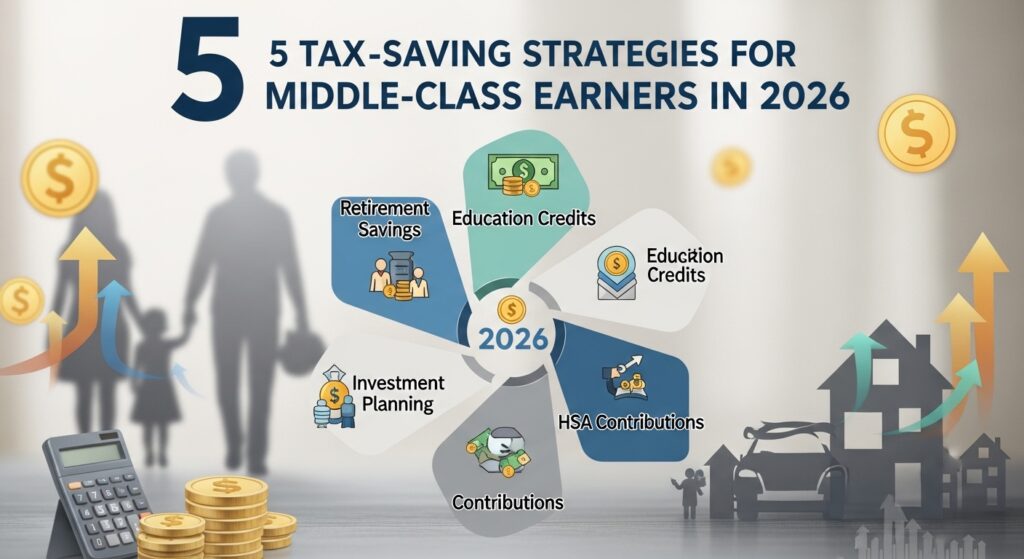
Summary Checklist for 2026
| Strategy | Action Item | Potential Impact |
| Retirement | Increase 401(k) contribution by 2% | Moderate to High |
| Healthcare | Maximize HSA contributions | High |
| New Deductions | Track overtime and U.S.-made car interest | Low to Moderate |
| Bunching | Accelerate donations/medical expenses | Moderate |
| Saver’s Credit | Check AGI eligibility for retirement credit | Low to Moderate |