For many, the hardest part of saving money isn’t the math—it’s the memory. Remembering to move money into a savings account feels like an extra chore in an already crowded day. Enter the “Round-Up” strategy, the digital-age equivalent of the old kitchen coin jar, which has become a cornerstone of financial wellness in 2026.
By automating the “spare change” from your daily transactions, you can build a meaningful financial buffer without ever feeling the pinch. Here is why this micro-saving tactic is taking over and how you can use it to turn pennies into thousands.
1. What Exactly is the “Round-Up” Strategy?
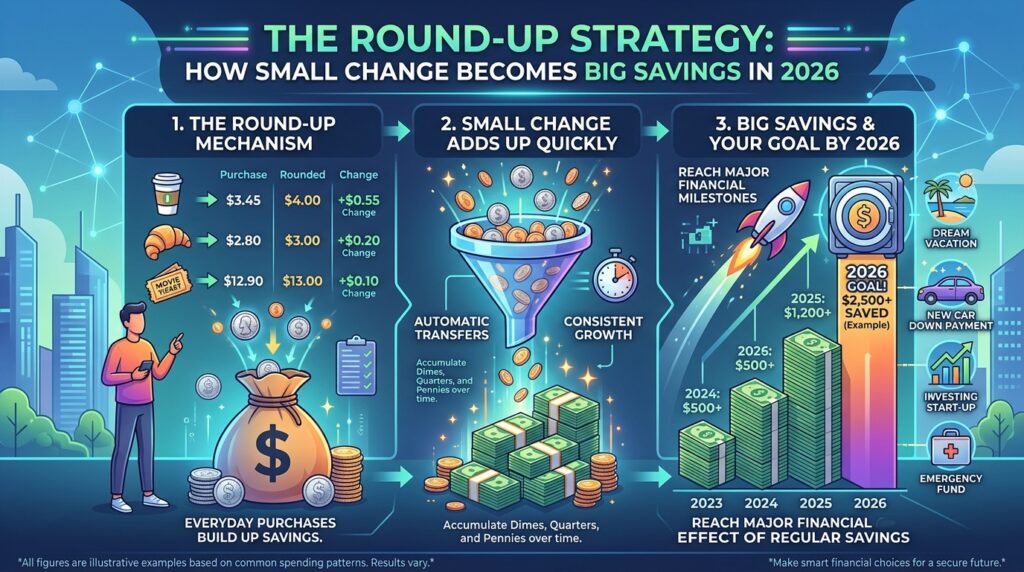
The logic is simple: every time you make a purchase with a linked debit or credit card, the transaction is rounded up to the nearest whole dollar. The “spare change” is then automatically swept into a separate savings or investment account.
The Math in Action:
- Morning Coffee: $4.25 → Rounded to $5.00 ($0.75 saved)
- Gas Station: $42.10 → Rounded to $43.00 ($0.90 saved)
- Grocery Run: $65.85 → Rounded to $66.00 ($0.15 saved)
- Daily Total: $1.80 saved
While $1.80 feels like nothing, if you do this every day, you’ve saved $657 in a year—enough to cover many common emergencies like a flat tire or a broken appliance.
2. Why It Works: The Psychology of “Frictionless” Finance
The reason most New Year’s resolutions to “save more” fail is decision fatigue. Every time you have to manually move money, your brain views it as a “loss” of spending power.
- Invisibility: Because the money leaves your account in increments of less than $1.00, your brain doesn’t register a change in your lifestyle.
- The Dopamine Hit: Checking your round-up app and seeing a $50 balance you “didn’t work for” provides a positive feedback loop that encourages more saving.
- Eliminating Procrastination: In 2026, “Automated” is the only way to ensure consistency. The system doesn’t forget, even when you do.
3. Best Round-Up Tools for 2026
Depending on your goals, different apps offer different “flavors” of rounding up.
For the “Set It and Forget It” Saver: Chime & Monzo
Many modern banks now build round-ups directly into their core product.
- How it works: Every time you use your bank’s debit card, the change goes into a high-yield “Savings Vault” within the same app.
- Pros: Immediate access to funds; usually earns interest (around 3.5%–4.0% APY in 2026).
For the Wealth-Builder: Acorns
Acorns pioneered the digital round-up and remains the leader for those who want their change to grow.
- How it works: Instead of a savings account, your change is invested into a diversified portfolio of ETFs (stocks and bonds).
- 2026 Update: Acorns now offers a “Multiplied Round-Up” feature. You can choose to save 2x, 3x, or 10x the spare change to accelerate your goals.
For the “Aggressive” Saver: Qapital
Qapital allows you to set “Rules” that go beyond simple rounding.
- The “Guilty Pleasure” Rule: Round up your change whenever you spend at a specific store (like Starbucks or Amazon).
- Pros: Highly customizable and great for specific goals like a “Europe 2027” fund.
4. The 2026 “Multi-Tier” Strategy: Taking it Further
If you’ve mastered the basic round-up, 2026 trends suggest “Power Rounding” to maximize your returns.
- The Double Round-Up: Set your app to round to the nearest $2.00 instead of $1.00. A $4.10 coffee now saves you $1.90 instead of $0.90.
- The “Sweep” Mechanism: Once your round-up account hits $500, many 2026 apps now offer an automatic “sweep” into a higher-interest Certificate of Deposit (CD) or a brokerage account to prevent “lazy cash.”
5. Potential Pitfalls to Watch For
While powerful, the round-up strategy isn’t without risks:
- The “Spending Paradox”: Don’t fall into the trap of thinking “The more I spend, the more I save.” Spending $5.00 to save $0.50 is still a net loss of $4.50.
- Account Fees: Some apps charge $3–$5 a month. If you only save $10 a month through round-ups, the fee is eating 50% of your progress. Always choose a bank or app with low or no fees for small balances.
- Overdraft Risk: If your checking account is very low, automated round-ups could push you into the negative. Ensure your app has “overdraft protection” that pauses transfers if your balance drops below a certain level.
Conclusion: Small Steps, Massive Results
The round-up strategy proves that building financial stability doesn’t require a six-figure salary or extreme sacrifice. By capturing the “leakage” in your daily spending, you turn the very act of consuming into an act of building.
In 2026, the wealthiest people aren’t just those who earn the most; they are the ones with the best systems. Start rounding up today—your future self will thank you for the “spare” change.