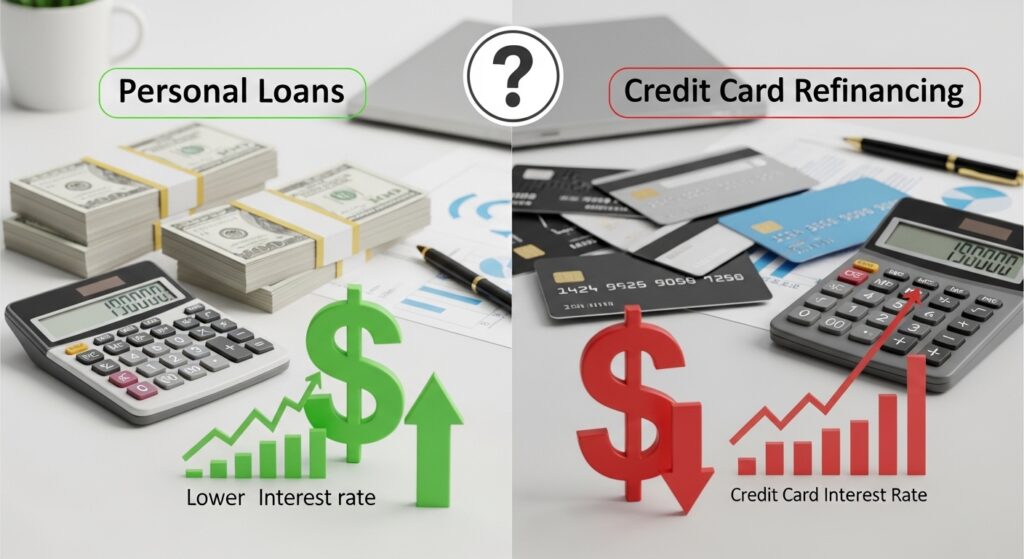
Personal Loans vs. Credit Card Refinancing: If you are carrying a balance on one or more credit cards, you are likely feeling the sting of 2026’s high-interest climate. Despite some minor rate cuts in late 2025, the average credit card APR remains stubbornly high at 22%.
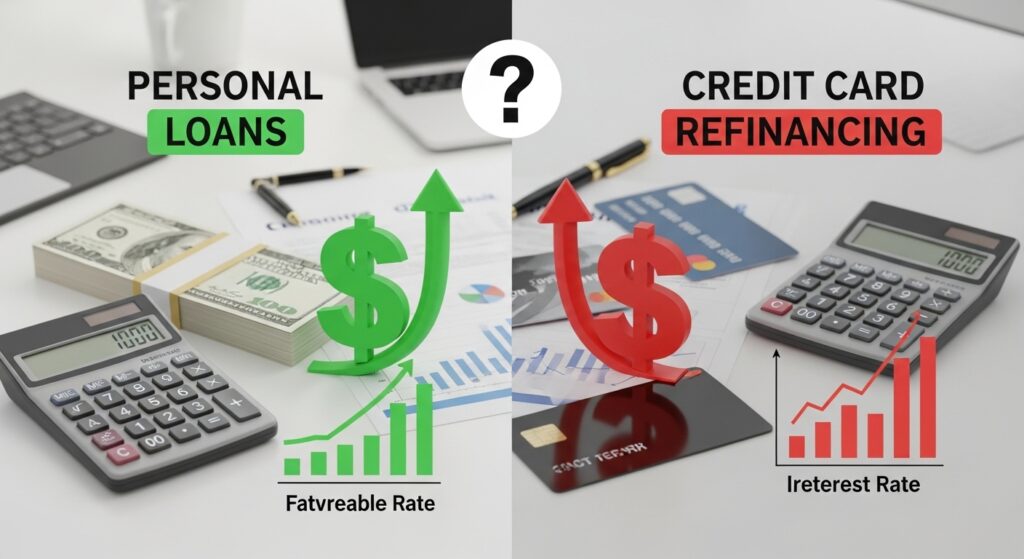
To escape this debt trap, most consumers look at two primary paths: Personal Loans (Debt Consolidation) or Credit Card Refinancing (Balance Transfers). Both can save you thousands, but choosing the wrong one for your specific debt level could actually cost you more in the long run.
In this guide, we break down the math, the fees, and the 2026 market trends to help you decide which path saves you the most.
1. Credit Card Refinancing: The 0% APR “Sprint”
Credit card refinancing usually involves moving your existing debt to a Balance Transfer Card.
How it Saves You Money
The primary appeal is the Introductory 0% APR period. In early 2026, top-tier cards are offering 12 to 18 months of zero interest on transferred balances. If you have $5,000 in debt and pay it off within a 15-month window, you pay zero dollars in interest.
The Catch: The Balance Transfer Fee
Almost all cards charge a one-time fee, typically 3% to 5% of the total amount transferred.
- Example: Transferring $10,000 with a 5% fee adds $500 to your balance immediately.
When it Saves More:
- Small to Mid-Sized Debt: If you owe less than $10,000 and can realistically pay it off in under 18 months.
- Excellent Credit: You generally need a FICO score of 690 or higher to qualify for the 0% offers.
2. Personal Loans: The “Marathon” Consolidation
A personal loan is an installment loan where you receive a lump sum to pay off your cards, then pay back the bank in fixed monthly installments.
How it Saves You Money
While not 0%, personal loan rates for 2026 are averaging around 12.15% for good-credit borrowers—nearly half the rate of a standard credit card.
- Fixed Payments: Unlike credit cards, the rate is fixed. If market rates spike again in late 2026, your payment stays the same.
- Longer Terms: You can spread the debt over 3 to 7 years, making the monthly payment much more affordable.
The Catch: Origination Fees
Many online lenders charge an Origination Fee (1% to 10%) which is deducted from your loan proceeds. You must account for this when calculating your total savings.
When it Saves More:
- Large Debt: If you owe more than $15,000 and need 3+ years to pay it back.
- Lower Credit Scores: It is often easier to get a personal loan with “Fair” credit (600–660) than it is to get a 0% balance transfer card.
3. Side-by-Side Comparison (2026 Data)
| Feature | Credit Card Refinancing | Personal Loan |
| Typical APR | 0% (Intro) then 20%+ | 7% – 24% (Fixed) |
| Upfront Fee | 3% – 5% Transfer Fee | 1% – 10% Origination Fee |
| Repayment Term | 12 – 21 Months | 2 – 7 Years |
| Impact on Credit | Lowers utilization (Good) | Diversifies credit mix (Good) |
| Best For | Paying off debt fast | Lowering monthly payments |
4. The Math: Which Saves More in 2026?
Let’s look at a real-world scenario: $10,000 in Credit Card Debt at 22% APR.
Scenario A: Balance Transfer Card (18 Months at 0%)
- Transfer Fee (5%): $500
- Monthly Payment: $583
- Total Interest Paid: $0
- Total Cost to Pay Off: $10,500
Scenario B: Personal Loan (3 Years at 11% APR)
- Origination Fee (3%): $300 (Built into the loan)
- Monthly Payment: $327
- Total Interest Paid: $1,772
- Total Cost to Pay Off: $11,772
The Winner? If you can afford the higher monthly payment ($583 vs $327), the Balance Transfer Card saves you an extra $1,272. However, if that $583 payment is too high and you fail to pay it off in 18 months, the credit card rate will jump to 25%+, potentially making the Personal Loan the safer, cheaper choice.
5. Vital 2026 Strategy: The “Credit Score Trap”
In 2026, lenders are using more advanced AI to monitor “Credit Seeking Behavior.”
- If you apply for a Balance Transfer and get rejected, your score will drop due to the hard inquiry.
- Pro Tip: Use “Pre-Qualification” tools for Personal Loans first. These use Soft Credit Pulls that don’t hurt your score, allowing you to see your guaranteed rate before you commit.
Final Verdict
- Choose Credit Card Refinancing if your debt is under $10k, your credit is great, and you have the discipline to “sprint” through the payments in a year.
- Choose a Personal Loan if you have “heavy” debt ($15k+), need a lower monthly payment to breathe, or want the security of a multi-year fixed plan.
Ready to see today’s best rates? Check out our [2026 Personal Loan Tier List] or our [Top 0% Balance Transfer Cards] for February.