Your credit score is one of the most important factors in determining whether you’ll be approved for a mortgage and what interest rate you’ll receive. A higher credit score can save you tens of thousands of dollars over the life of a mortgage, while a lower score can result in higher interest rates, larger down payment requirements, or even loan denial. If your credit score isn’t where you want it to be, the good news is that you can improve it relatively quickly with focused effort. This comprehensive guide provides actionable strategies to fix your credit score fast before applying for a mortgage.
Understanding Your Credit Score: The Basics
Before you can fix your credit score, you need to understand what it is and how it’s calculated.
What is a Credit Score?
A credit score is a three-digit number (typically 300-850) that represents your creditworthiness—your likelihood of repaying borrowed money on time. Lenders use this score to assess risk and determine whether to approve your loan application and what interest rate to offer.
Credit Score Ranges:
- Excellent: 750-850 (Best rates and terms)
- Very Good: 700-749 (Good rates and terms)
- Good: 650-699 (Acceptable rates and terms)
- Fair: 600-649 (Higher rates, limited options)
- Poor: Below 600 (Difficult to qualify, highest rates)
Mortgage Credit Score Requirements:
Most mortgage lenders require a minimum credit score of 620 for conventional loans, though FHA loans may accept scores as low as 580. However, to qualify for the best rates, lenders typically prefer scores of 740 or higher.
How Credit Scores Are Calculated: The Five Factors
Your credit score is calculated based on five key factors, each with different weight:
1. Payment History (35%)
Your payment history is the most important factor in your credit score. It tracks whether you’ve paid your bills on time. Late payments, collections, and charge-offs significantly damage your score.
- On-Time Payments: Increase your score
- Late Payments (30+ days): Decrease your score
- Collections or Charge-Offs: Severely damage your score
2. Credit Utilization (30%)
Credit utilization is the percentage of your available credit that you’re currently using. For example, if you have a $10,000 credit limit and a $3,000 balance, your utilization is 30%.
- Low Utilization (Below 30%): Increases your score
- High Utilization (Above 70%): Decreases your score
- Maxed Out Credit (100%): Severely damages your score
3. Length of Credit History (15%)
This factor considers how long you’ve had credit accounts. A longer credit history generally indicates more experience managing credit responsibly.
- Longer History: Increases your score
- Newer Accounts: May decrease your score
- Average Age of Accounts: Matters more than individual account age
4. Credit Mix (10%)
This factor considers the variety of credit types you have, including credit cards, auto loans, mortgages, and personal loans. Having different types of credit demonstrates your ability to manage various credit products.
- Diverse Credit Mix: Increases your score
- Only Credit Cards: May limit score potential
- Multiple Account Types: Demonstrates credit management ability
5. New Credit Inquiries (10%)
This factor tracks how many times you’ve recently applied for new credit. Multiple applications in a short period can lower your score.
- Few Recent Inquiries: Increases your score
- Multiple Recent Inquiries: Decreases your score
- Hard Inquiries vs. Soft Inquiries: Only hard inquiries affect your score
Quick Wins: Fast Credit Score Improvements (30-60 Days)
If you’re applying for a mortgage soon, focus on these quick wins that can improve your score relatively quickly.
1. Reduce Credit Card Balances (Fastest Impact)
Reducing your credit card balances is one of the fastest ways to improve your credit score because it directly impacts your credit utilization ratio.
Action Steps:
- Pay down credit card balances to below 30% of your credit limit
- If possible, pay off cards entirely
- Focus on cards with the highest utilization first
- Even small reductions can improve your score
Expected Impact: 10-50 point improvement within 1-2 billing cycles (30-60 days)
2. Dispute Errors on Your Credit Report
Errors on your credit report can significantly damage your score. The Fair Credit Reporting Act allows you to dispute inaccurate information.
Action Steps:
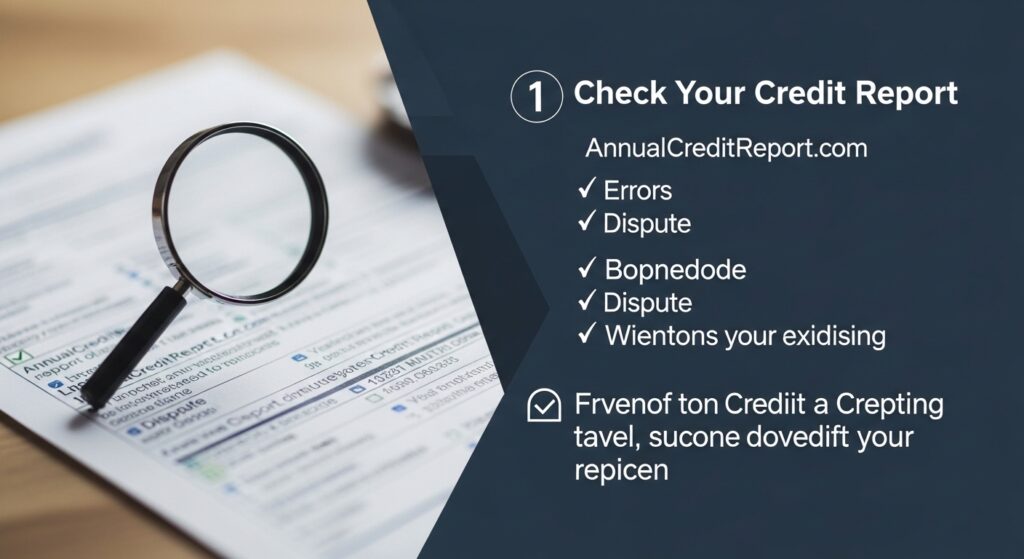
- Obtain your free credit reports from AnnualCreditReport.com
- Review all three reports (Equifax, Experian, TransUnion)
- Identify errors or inaccuracies
- File disputes with the credit bureaus
- Follow up on dispute status
Common Errors to Look For:
- Accounts that aren’t yours
- Incorrect payment statuses
- Duplicate accounts
- Wrong account balances
- Incorrect personal information
Expected Impact: 10-100+ point improvement if errors are corrected
3. Become an Authorized User
If someone with good credit adds you as an authorized user on their account, their positive payment history may be added to your credit report.
Action Steps:
- Ask a family member or friend with good credit to add you as an authorized user
- Ensure the account has a long positive payment history
- Verify the account appears on your credit report
- Note: You don’t need to use the card; just being added helps
Expected Impact: 10-50 point improvement depending on the account’s history
4. Pay Bills On Time Going Forward
While this won’t immediately fix past late payments, starting to pay all bills on time now will prevent further score damage and begin rebuilding your score.
Action Steps:
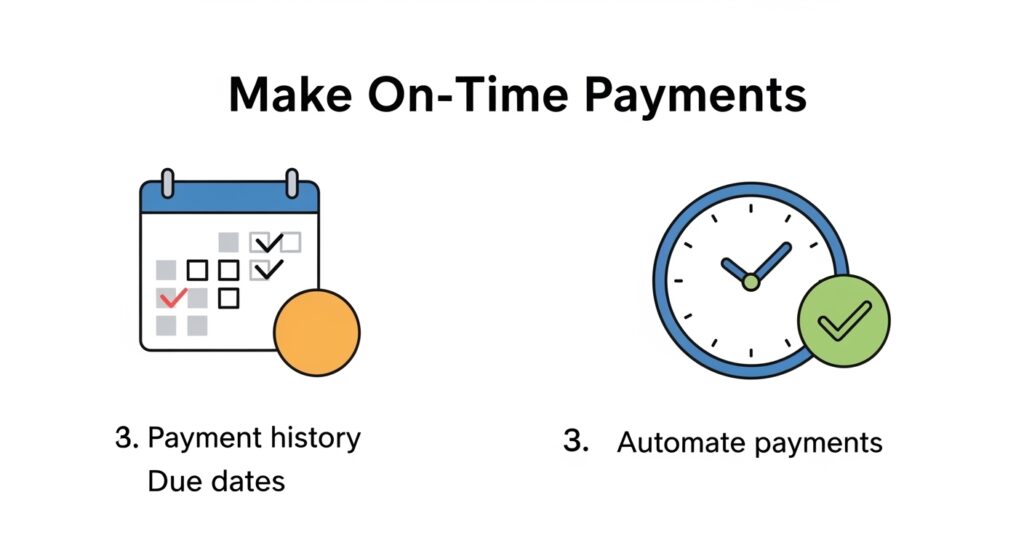
- Set up automatic payments for all bills
- Use calendar reminders for bills without auto-pay options
- Pay at least the minimum payment on time
- Consider paying more than the minimum to reduce balances faster
Expected Impact: Prevents further damage; positive impact grows over time
Medium-Term Improvements: 60-180 Days
If you have more time before applying for a mortgage, implement these strategies for more significant improvements.
5. Pay Down Debt Strategically
Beyond just reducing credit card balances, develop a strategic debt payoff plan.
Debt Payoff Strategies:
- Avalanche Method: Pay off highest-interest debt first (saves money)
- Snowball Method: Pay off smallest balances first (psychological wins)
- Targeted Method: Focus on high-utilization accounts first (fastest score improvement)
Action Steps:
- List all debts with balances and utilization rates
- Allocate extra funds to the highest-priority debt
- Make minimum payments on other accounts
- Track progress monthly
Expected Impact: 20-100 point improvement over 60-180 days
6. Negotiate with Creditors
If you have late payments or collections accounts, contact creditors to negotiate better terms.
Negotiation Strategies:
- Pay for Delete: Offer to pay the debt in exchange for removal from your credit report
- Goodwill Adjustment: Ask creditors to remove late payments due to hardship
- Settlement: Negotiate to pay less than the full amount owed
- Payment Plans: Set up a plan to catch up on late payments
Action Steps:
- Contact creditors in writing
- Explain your situation and request consideration
- Document all communications
- Get agreements in writing before paying
Expected Impact: 20-50 point improvement per account if successful
7. Increase Credit Mix (Carefully)
If you only have credit cards, adding other types of credit can improve your score. However, be cautious about taking on unnecessary debt.
Credit Mix Options:
- Secured Credit Card: Requires a deposit but helps build credit
- Credit Builder Loan: Designed specifically to build credit
- Authorized User Status: As mentioned earlier
- Installment Loan: Auto loan or personal loan (only if needed)
Action Steps:
- Consider your financial situation carefully
- Only take on new credit if necessary
- Ensure you can manage the new account responsibly
- Space out applications (multiple applications hurt your score)
Expected Impact: 10-30 point improvement from credit mix diversification
Long-Term Improvements: 180+ Days
For more significant score improvements, implement these longer-term strategies.
8. Address Negative Items
Negative items like collections, charge-offs, and foreclosures significantly damage your score. While they can’t be removed if accurate, their impact decreases over time.
Timeline of Impact:
- 30-Day Late Payment: Impacts score for 7 years
- 60-Day Late Payment: Impacts score for 7 years (more severe)
- Collections Account: Impacts score for 7 years
- Charge-Off: Impacts score for 7 years
- Foreclosure: Impacts score for 7 years
- Bankruptcy: Impacts score for 7-10 years
Action Steps:
- Identify all negative items on your report
- Verify they’re accurate (dispute if inaccurate)
- Develop a plan to address them (pay, negotiate, or wait)
- Focus on newer negative items first (they hurt more)
Expected Impact: Gradual improvement as negative items age
9. Build a History of On-Time Payments
The most important factor in your credit score is payment history. Building a consistent record of on-time payments is the most effective long-term strategy.
Action Steps:
- Pay all bills on time, every time
- Set up automatic payments to ensure you don’t miss payments
- Keep accounts open even after paying them off
- Maintain low balances on credit cards
Expected Impact: Continuous improvement over time; most significant factor
10. Maintain Low Credit Utilization Permanently
Once you’ve reduced your credit utilization, maintain it at low levels going forward.
Best Practices:
- Keep utilization below 10% for maximum score benefit
- Request credit limit increases to lower utilization
- Avoid maxing out credit cards
- Pay off balances before statement closing date if possible
Expected Impact: Sustained score improvement
Credit Score Timeline: How Long Does Improvement Take?
The timeline for credit score improvement depends on your starting point and the strategies you implement.
Scenario 1: High Utilization (620 Score)
- Month 1: Reduce utilization to 30% → Score: 650-670
- Month 2: Reduce utilization to 10% → Score: 680-700
- Month 3: Continue paying on time → Score: 700-720
Scenario 2: Recent Late Payment (580 Score)
- Month 1: Dispute errors, become authorized user → Score: 600-620
- Month 2: Pay down balances → Score: 620-640
- Month 3: Continue on-time payments → Score: 640-660
- Month 6: Late payment aging impact → Score: 680-700
Scenario 3: Collections Account (550 Score)
- Month 1: Dispute errors, negotiate with creditor → Score: 570-590
- Month 2: Pay collections account → Score: 590-610
- Month 3-6: Build positive payment history → Score: 620-660
- Month 12+: Collections account aging impact → Score: 700+
Mortgage Lending Considerations
Understanding what mortgage lenders look for helps you prioritize your credit repair efforts.
Credit Score Thresholds:
- Below 620: Difficult to qualify for conventional loans; FHA may be option
- 620-639: Qualify for FHA loans; conventional loans possible at higher rates
- 640-679: Qualify for conventional loans; rates higher than excellent credit
- 680-719: Good rates available; competitive mortgage options
- 720+: Best rates available; maximum mortgage options
Other Factors Lenders Consider:
Beyond your credit score, mortgage lenders also evaluate:
- Debt-to-Income Ratio: Typically must be below 43-50%
- Down Payment: Larger down payments improve approval chances
- Employment History: Stable employment is preferred
- Savings and Assets: Demonstrates financial stability
- Recent Late Payments: More recent late payments are viewed more negatively
Pre-Approval Timeline:
If you’re planning to apply for a mortgage, consider this timeline:
- Month 1-2: Implement quick wins (reduce utilization, dispute errors)
- Month 2-3: Verify score improvements and monitor progress
- Month 3-4: Get pre-approved for mortgage
- Month 4+: Begin home shopping and make offer
Avoiding Credit Repair Scams
While working to improve your credit, be aware of credit repair scams that promise unrealistic results.
Red Flags:
- Guaranteed Results: No one can guarantee credit score improvements
- Upfront Fees: Legitimate credit repair services don’t charge upfront
- Removal of Accurate Information: Accurate negative items can’t be removed
- Unrealistic Timelines: Significant improvements take time
- Pressure to Act Quickly: Legitimate services don’t pressure you
Legitimate Options:
- DIY Credit Repair: Free and effective; dispute errors yourself
- Credit Counseling: Non-profit agencies offer free counseling
- Credit Repair Services: Legitimate services charge after results
- Mortgage Broker Assistance: Many brokers provide credit guidance
Action Plan: Your 90-Day Credit Score Improvement Plan
Week 1: Assessment and Quick Wins
- Obtain free credit reports from AnnualCreditReport.com
- Review reports for errors and negative items
- File disputes for any inaccuracies
- Check current credit utilization
- Pay down highest-utilization credit cards
Week 2-4: Aggressive Debt Reduction
- Allocate extra funds to credit card payoff
- Reduce utilization to below 30%
- Set up automatic bill payments
- Contact creditors about late payments or collections
- Become an authorized user if possible
Week 5-8: Monitoring and Optimization
- Check credit score progress
- Verify dispute results
- Continue aggressive debt payoff
- Ensure all payments are on time
- Maintain low utilization
Week 9-12: Pre-Approval Preparation
- Verify final credit score
- Gather mortgage pre-approval documents
- Contact mortgage lenders
- Get pre-approved
- Begin home shopping
Conclusion: Your Path to Mortgage Readiness
Improving your credit score before applying for a mortgage is one of the best investments you can make. Even a 50-point improvement can result in a lower interest rate, saving you tens of thousands of dollars over the life of your mortgage.
By implementing the strategies outlined in this guide—reducing credit utilization, disputing errors, paying bills on time, and building positive credit history—you can significantly improve your credit score in as little as 30-90 days. The key is taking action now and maintaining good credit habits going forward.
Remember, mortgage lenders want to approve qualified borrowers. By demonstrating responsible credit management and improving your credit score, you’re making it easier for lenders to say yes to your mortgage application at the best possible rates.
Quick Reference: Credit Score Improvement Checklist
| Action | Timeline | Impact | Priority |
|---|---|---|---|
| Reduce Credit Card Balances | 30-60 days | 10-50 points | High |
| Dispute Credit Report Errors | 30-60 days | 10-100+ points | High |
| Become Authorized User | 30-60 days | 10-50 points | Medium |
| Pay Bills On Time | Ongoing | 5-20 points/month | High |
| Pay Down Debt | 60-180 days | 20-100 points | High |
| Negotiate with Creditors | 60-90 days | 20-50 points | Medium |
| Address Collections | 180+ days | 50-100+ points | High |
| Build Payment History | 180+ days | 50-100+ points | High |
| Maintain Low Utilization | Ongoing | 10-30 points | High |
| Diversify Credit Mix | 60-180 days | 10-30 points | Low |