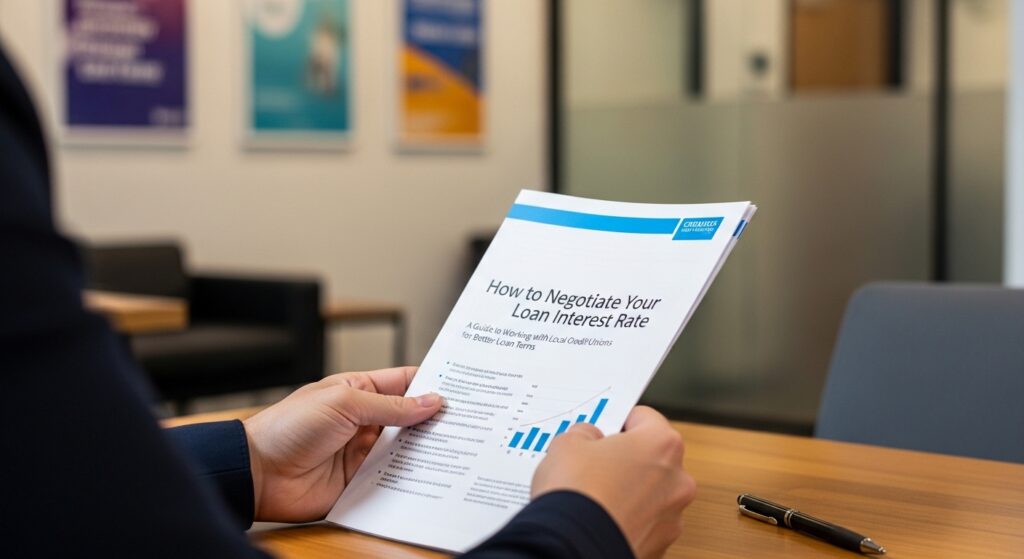
Negotiate with a local credit union is different than dealing with a national bank. Because credit unions are member-owned nonprofits, they are often more flexible and relationship-driven. However, in the “higher-for-longer” interest rate environment of early 2026, you need a precise strategy to get them to move the needle.
As of February 2026, average credit union auto rates are hovering around 5.25% to 5.50%, while personal loans sit near 10.7%. Here is how to negotiate those numbers down.
1. Leverage the “Relationship Advantage”
Credit unions exist to serve their members. If you’ve been a member for years, you have “social capital” that a big bank doesn’t recognize.
- The Move: Before asking for a lower rate, ensure you have multiple products with them (checking, a small savings account, or a credit card).
- The Script: “I’ve been a member since 2019 and have my direct deposit here. I’d prefer to keep my new auto loan with you rather than moving it to an online lender, but I’ve seen rates as low as 4.9% elsewhere. What can we do to close that gap?”
2. Bring a “Paper Trail” of Competitor Offers
You cannot negotiate based on a “feeling.” You need a written quote. In 2026, online lenders like LightStream or SoFi often set the floor for rates.
- The Move: Get a “pre-qualified” offer from an online competitor. It usually only requires a soft credit pull.
- The Strategy: Show the credit union the APR and the terms. Credit unions often have a “rate match” policy that isn’t publicly advertised but can be triggered by a loan officer to prevent losing a loyal member.
3. Focus on the “Margin,” Not the “Prime”
Interest rates are composed of two parts: the Index (like the Prime Rate, which the credit union can’t change) and the Margin (the profit/risk markup, which they can change).
- The Tactic: Ask if they can reduce the “risk premium” based on your specific financial strength.
- Your Leverage Points:
- Credit Score: If your score has jumped 50+ points since your last loan, you are a lower risk.
- DTI (Debt-to-Income): If your DTI is below 30%, highlight this as proof of your ability to pay.
4. Offer a Larger “Skin in the Game” (Down Payment)
The more of your own money you put down, the less risk the credit union takes.
- The Move: If they are quoting you 6.5% for an auto loan with 10% down, ask: “If I increase my down payment to 25%, can we drop the rate to 5.9%?” This lowers the Loan-to-Value (LTV) ratio, which often triggers an automatic move into a lower “rate tier” in their system.
5. Use “Relationship Discounts” as a Closer
Many credit unions offer “automatic” discounts that the loan officer might not mention unless prompted.
- Common 2026 Discounts:
- Autopay Discount: Usually a 0.25% to 0.50% reduction for setting up automatic transfers from a linked checking account.
- Loyalty Bonus: A small reduction (0.10%–0.25%) if you’ve had an account for 5+ years.
- Green Discount: Many credit unions in 2026 offer lower rates for electric vehicles (EVs) or energy-efficient home improvements.
Summary of Negotiation Leverage
| Strategy | Difficulty | Impact |
| Rate Matching | Medium | High (can save 1.0%+) |
| Autopay Enrollment | Easy | Low (0.25% – 0.50%) |
| Lowering LTV (Higher Down Payment) | Hard | Medium (0.50% – 1.0%) |
| Improving Credit Tier | Hard | Very High (up to 3.0%) |

A Critical 2026 Tip: The “Retention Team”
If the initial loan officer says “no,” ask to speak with the Retention or Member Experience manager. They often have higher discretionary authority to override the standard “rate sheet” to keep a high-value member from leaving.