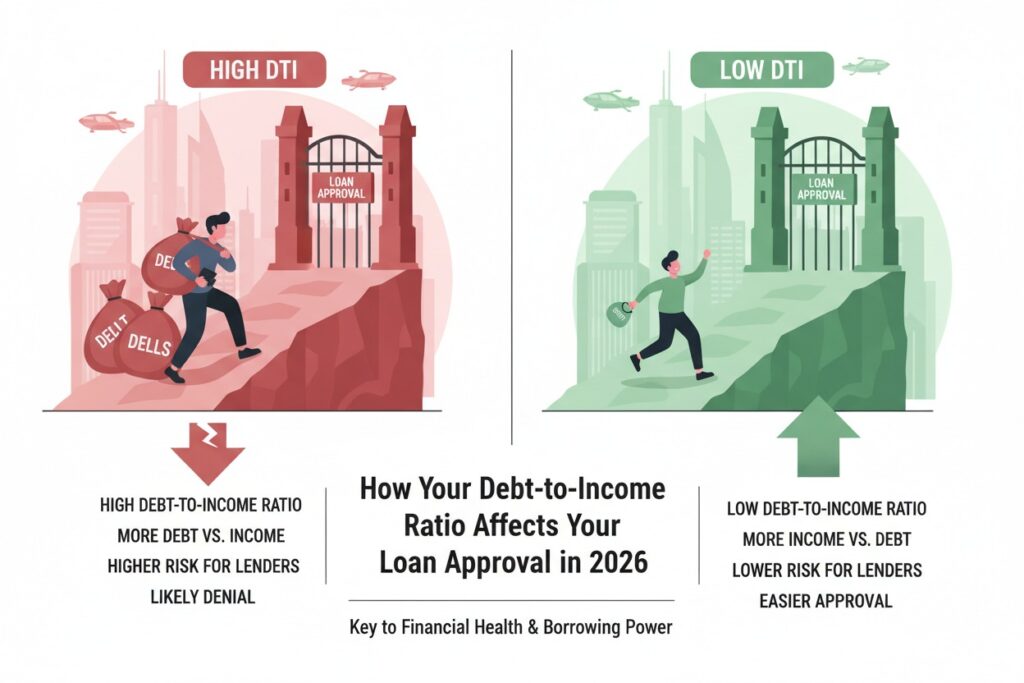
How Your Debt-to-Income Ratio Affects Your Loan Approval: In March 2026, lenders are no longer just looking at your credit score; they are obsessed with your Debt-to-Income (DTI) ratio. With interest rates stabilizing around 6% for mortgages and 12% for personal loans, your DTI is the primary tool banks use to see if you have the “breathing room” to handle a new monthly payment.
Here is the 2026 guide to understanding, calculating, and optimizing your DTI for a successful loan approval.
1. What is the Debt-to-Income (DTI) Ratio
Your DTI is a percentage that shows how much of your gross monthly income (before taxes) goes toward paying your fixed monthly debts. Unlike your credit score, which shows how you pay your bills, your DTI shows if you can afford to take on more.

2. The Two Types of DTI Lenders Use
In 2026, most mortgage lenders use a “split” view to assess your risk, often referred to as the 28/36 Rule.
A. Front-End Ratio (The Housing Ratio)
This only includes your proposed housing costs: mortgage principal, interest, taxes, and insurance (PITI).
- 2026 Target: Lenders generally want this at 28% or lower.
B. Back-End Ratio (The Total Debt Ratio)
This is the most critical number. It includes your housing costs plus all other recurring debts:
- Car loans
- Student loans
- Credit card minimum payments
- Personal loans & BNPL installments
- Child support or alimony
- 2026 Target: Lenders typically look for 36%, though many will go up to 43% for qualified mortgages.
3. 2026 Thresholds: What is a “Good” DTI?
Approval standards have tightened this year. Here is how lenders view your percentage in the current economy:
| DTI Range | Approval Status | Lender Perception |
| Below 36% | Excellent | You have plenty of cushion; you’ll get the best rates. |
| 36% – 43% | Good | Manageable. Most conventional and FHA lenders will approve you. |
| 44% – 50% | Risky | May require “compensating factors” like high savings or a 740+ credit score. |
| Above 50% | Critical | High risk of denial. You are spending half your income on debt. |
4. How DTI Requirements Vary by Loan Type
- Conventional Mortgages: Strict 36% preference, though can go to 45% with high equity.
- FHA Loans: More lenient, often allowing up to 57% back-end DTI if you have a high credit score.
- VA Loans: Technically no set limit, but a 41% DTI is the benchmark for automated approval.
- Auto Loans: Often the most flexible, sometimes allowing up to 50% DTI because the car is easily repossessable.
5. How to Lower Your DTI Before Applying
If your DTI is over 43%, you have two levers to pull: Decrease Debt or Increase Income.
- Pay Down Small Balance Loans: DTI looks at monthly payments, not total debt. Paying off a $500 credit card balance that has a $50 monthly minimum helps your DTI more than paying $500 toward a $20,000 student loan.
- Avoid New Credit: Do not finance furniture or a new car in the 6 months leading up to a mortgage application.
- Extend Your Term: If you have a high-payment 3-year car loan, refinancing it to a 5-year term (if the rate is low) will lower your monthly payment and improve your DTI.
- Include All Income: Don’t forget to count side-hustles, bonuses, or alimony in your “Gross Income” total.

Conclusion: The “Invisible” Limit
While a high credit score might get you in the door, a high DTI will keep it closed. In 2026, being “pre-approved” means proving that you aren’t overextended. Use an interest rate calculator to estimate your new mortgage payment, add it to your current debts, and make sure that final number stays under 43% for the smoothest path to approval.