Compare SEP IRA vs. Solo 401k with 2026 limits. Discover the best retirement planning strategy for gig workers to maximize tax savings and build long-term wealth.
In 2026, the “gig economy” isn’t a side hustle anymore—it’s the backbone of the global economy. Whether you are a freelance developer, a digital consultant, or a creative agency owner, you’ve traded the corporate ladder for freedom. But that freedom comes with a significant trade-off: the disappearance of the company-sponsored 401(k) and the “free money” of an employer match.
For the self-employed, retirement planning isn’t just about saving; it’s about sophisticated tax engineering. Choosing between a SEP IRA and a Solo 401(k) can mean the difference between retiring five years early or working well into your 70s. This guide breaks down the 2026 regulations to help you choose the right path for your unique business model.
1. Why Gig Workers Can’t Afford to Wait
Traditional employees often have retirement savings automated. For gig workers, the burden is 100% personal. However, the IRS provides a “secret weapon”: higher contribution limits than almost any W-2 worker can access.
The Power of Compounding in the Gig World
If you contribute $2,000 a month starting at age 30, at a 7% average annual return, you’ll have over $1.5 million by age 65. If you wait until 40 to start, that number drops to roughly $710,000. For a freelancer with fluctuating income, the “lost decade” of not planning is the biggest tax you’ll ever pay. Retirement Planning

2. The SEP IRA: Simplicity and Scalability
The Simplified Employee Pension (SEP) IRA has long been the favorite of the “accidental freelancer.” It’s designed for simplicity.
How it Works in 2026
A SEP IRA allows you to contribute a portion of your net self-employment income. The IRS views you as both the employer and the employee. However, all contributions are considered “employer-side.”
- 2026 Contribution Limit: You can contribute up to 25% of your net adjusted self-employment income, capped at $72,000.
- The “Paperwork-Free” Plan: You can open a SEP IRA at nearly any brokerage (Vanguard, Fidelity, Schwab) in about 15 minutes.
- Deadline Flexibility: Unlike other plans, you can fund a SEP IRA as late as your tax filing deadline, including extensions. This makes it perfect if you don’t know your final profit until April (or October).
The Catch with SEP IRAs
The 25% rule is a double-edged sword. To hit the $72,000 maximum in 2026, you would need to earn roughly $360,000 in net profit. For most gig workers earning $80,000–$150,000, the Solo 401(k) actually allows for higher contributions.

3. The Solo 401(k): The High-Octane Wealth Builder
If the SEP IRA is a reliable sedan, the Solo 401(k) is a turbocharged sports car. It’s designed for the one-person business (and their spouse) who wants to maximize every cent of tax-advantaged space.
Why the Solo 401(k) Wins on Lower Incomes
The Solo 401(k) allows you to contribute in two ways:
- Elective Deferral (Employee): Up to $24,500 (for 2026).
- Profit Sharing (Employer): Up to 25% of your net income.
Example: If you earn $100,000 net:
- SEP IRA: Max contribution is $25,000.
- Solo 401(k): You can contribute $24,500 (employee) PLUS roughly $20,000 (employer), totaling $44,500.
2026 “Super Catch-Up” Provisions
Under the SECURE 2.0 Act, 2026 introduces a unique opportunity for older gig workers:
- Ages 50–59: $8,000 catch-up (Total: $80,000). Retirement Planning
- Ages 60–63: A special “Super Catch-Up” of $11,250, allowing a total contribution of $83,250.
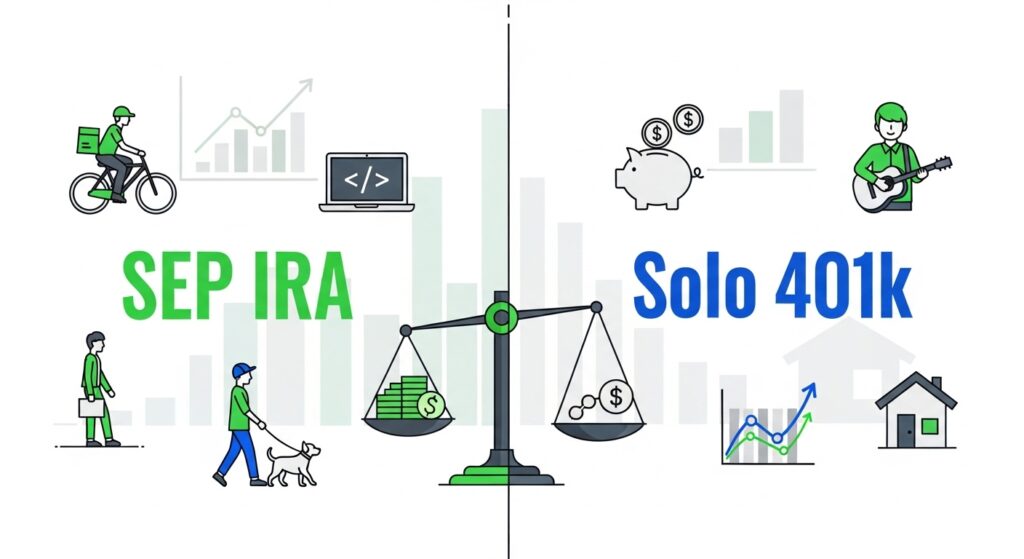
4. SEP IRA vs. Solo 401(k): Side-by-Side Comparison (2026)
| Feature | SEP IRA | Solo 401(k) |
| Max Total Contribution | $72,000 | $72,000 ($83k+ with catch-ups) |
| Setup Ease | High (Minutes) | Moderate (Requires EIN/Plan Doc) |
| Catch-up Contributions | No | Yes |
| Roth Option | New (Varies by provider) | Highly available |
| Plan Loans | No | Yes (up to $50k) |
| Annual IRS Filing | No | Yes (Form 5500-EZ if >$250k assets) |
5. The Roth Revolution: Pay Tax Now or Later?
In 2026, more gig workers are opting for Roth Solo 401(k)s. With tax rates historically low but federal debt high, paying taxes on your contributions today in exchange for tax-free withdrawals in 30 years is a hedge against future tax hikes.
Important Note: Starting in 2026, the IRS requires high earners (over $145,000 in the prior year) to make their catch-up contributions to a Roth account. This is a mandatory shift you must discuss with your CPA.
6. Case Studies: Which Professional Are You?
Scenario A: The High-Volume Consultant
- Income: $250,000/year.
- Goal: Simplicity and high deductions.
- Winner: SEP IRA. At this income level, the 25% limit ($62,500) is close enough to the 401(k) max that the ease of a SEP IRA outweighs the paperwork of a 401(k).
Scenario B: The Growing Freelancer
- Income: $75,000/year.
- Goal: Maximize savings.
- Winner: Solo 401(k). The 401(k) allows this worker to save nearly $40,000, whereas the SEP IRA would cap them at $18,750.
7. How to Set Up Your Plan (Step-by-Step)
- Obtain an EIN: Even if you’re a sole proprietor, you’ll need an Employer Identification Number from the IRS for a Solo 401(k).
- Choose a Provider: Look for low-fee providers like Vanguard, Charles Schwab, or E*Trade. For “Mega Backdoor Roth” strategies, look at boutique providers like Solo401k.com. Retirement Planning
- Calculate Your “Net”: Remember that “net income” for retirement purposes is your profit minus half of your self-employment tax.
- Automate the “Tax Bill”: Set your account to pull a percentage of every invoice automatically.
Conclusion: Take Control of Your Future
Gig workers are the CEOs of their own lives. You wouldn’t run your business without a budget; don’t run your life without a retirement plan. Whether you choose the ease of the SEP IRA or the massive power of the Solo 401(k), the key is to start before the 2026 tax year ends.
At yourfinancerates.com, we believe financial independence is the ultimate “gig.” Don’t let your hard-earned money disappear into the IRS’s pockets when it could be growing your future.