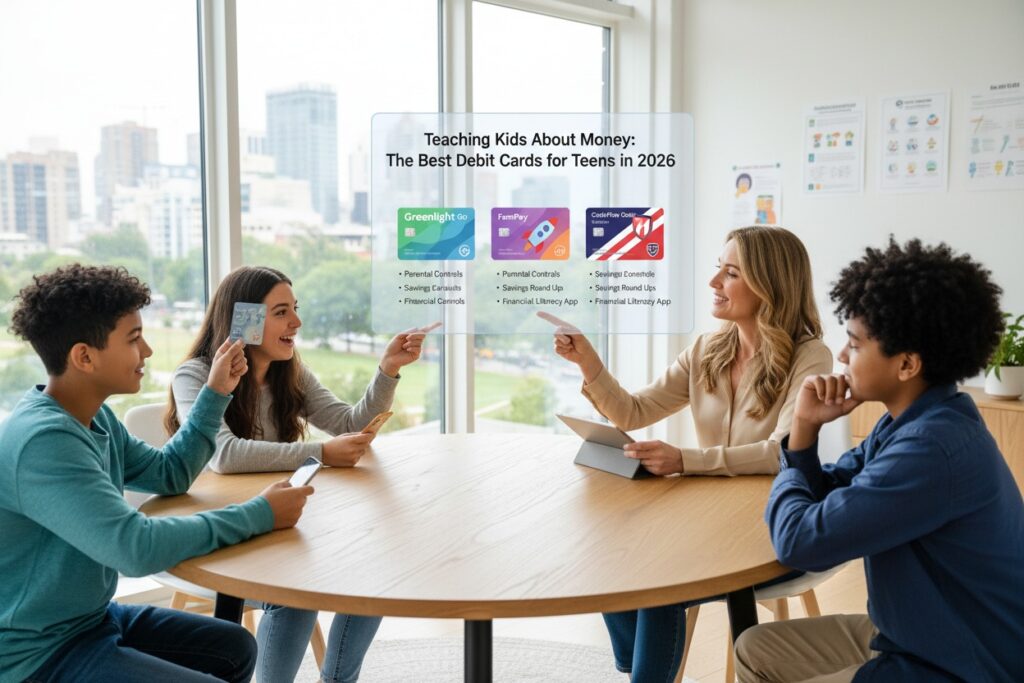
Teaching Kids About Money: In 2026, the “digital piggy bank” has evolved into a sophisticated financial training ground. For parents in Cambodia or abroad, choosing a debit card for your teen is no longer just about convenience—it’s about finding the right balance between independence and parental guardrails.
As of March 2026, here is the breakdown of the top teen debit cards and how they stack up for financial education.
1. Top Picks for 2026 at a Glance
| Card | Monthly Fee | Best For | Key Feature |
| Greenlight | $5.99 – $14.98 | All-in-One Learning | Chores, Investing, and up to 6% Savings Reward |
| Step | $0 | Credit Building | “Credit-builder” card that works like debit |
| Chase First Banking | $0 | Chase Customers | Total parental control over specific stores |
| Capital One MONEY | $0 | No-Fee Simplicity | Interest-earning checking for ages 8+ |
| GoHenry (Acorns) | $4.99+ | Gamified Learning | “Money Missions” interactive lessons |
2. The Comprehensive Review: Which One Fits Your Teen?
The “Gold Standard”: Greenlight
Greenlight remains the most powerful tool for parents who want a “classroom in an app.”
- The Power of Automation: You can assign chores and automate allowance transfers.
- Safety Features: It is one of the few cards that allows you to set spending limits for specific types of stores (e.g., $20 at restaurants, $0 at gaming stores).
- 2026 High Yield: Their premium plans offer up to 6% savings rewards on balances up to $5,000—a rate that beats most adult high-yield savings accounts this year.
The “Future Pro”: Step
If your teen is 13+ and looking toward adulthood, Step is the clear winner because it helps build a credit history before they turn 18.
- How it works: It’s technically a “secured” credit card that functions exactly like a debit card. You can only spend what you deposit, but Step reports the positive “payment history” to credit bureaus.
- Cost: $0 monthly fee, making it the best “budget-friendly” option for older teens.
The “Big Bank” Choice: Chase First Banking
For parents who already bank with Chase, this is the most seamless integration.
- Pros: No monthly fees and access to 15,000+ Chase ATMs. It lives directly inside your existing Chase app, making transfers instant.
- Cons: You must have a Chase checking account to open it, and it lacks the advanced “investing” or “credit building” features of fintech rivals.
3. Beyond the Card: Teaching “Digital Money” Skills
Giving a teen a piece of plastic without a plan is a recipe for overspending. In 2026, financial literacy means mastering these three areas:
- The “24-Hour Rule”: Teach your teen to wait 24 hours before any purchase over $50. In an era of “One-Click” buying, this builds necessary friction.
- Tracking “Invisible” Subscriptions: Use the app’s notification system to show them how small $5/month gaming or app subscriptions can drain a balance.
- The Savings “Tax”: Encourage them to move 20% of every deposit (allowance or job pay) into their “Savings Vault” before they spend a dime.
4. Security & Safety in 2026
Teenagers are prime targets for social media financial scams. Ensure any card you choose has:
- Instant Freeze: The ability for both the parent and teen to lock the card instantly via the app if it’s lost.
- Real-Time Alerts: You should get a notification the second a purchase is made.
- FDIC Insurance: This ensures the money is protected by the government (up to $250,000) if the bank fails.

Conclusion: Start with a Goal
If your goal is to build credit, go with Step. If you want a full curriculum of chores and investing, Greenlight is worth the monthly fee. If you just want a simple, free tool and already bank with a major institution, Chase or Capital One are excellent starting points.