The Beginner’s Guide to Sinking Funds: Have you ever felt like your budget was perfectly on track, only for an “unexpected” expense to come along and derail everything? Maybe it was the annual car registration, a semi-annual insurance premium, or the realization that the holidays are just two months away and you haven’t saved a dime for gifts. These aren’t actually emergencies—they are predictable expenses that we simply failed to plan for.
Enter the sinking fund.
In this comprehensive 2000-word guide, we will demystify one of the most powerful yet underutilized tools in personal finance. We’ll explore what sinking funds are, how they differ from other types of savings, and why they are the secret to a stress-free financial life in 2026. Whether you are living paycheck to paycheck or looking to optimize a healthy surplus, sinking funds are the missing piece of your budgeting puzzle.
Table of Contents
- What is a Sinking Fund?
- Sinking Fund vs. Emergency Fund vs. General Savings
- The Psychology of Sinking Funds: Why They Work
- Top 10 Sinking Fund Categories for 2026
- How to Calculate Your Sinking Fund Needs
- Where to Keep Your Sinking Funds
- Step-by-Step: How to Start Your First Sinking Fund
- Common Mistakes to Avoid
- Frequently Asked Questions (FAQs)
- Conclusion: Your Path to Financial Peace
What is a Sinking Fund? {#what-is-a-sinking-fund}
At its core, a sinking fund is a strategic way to save money by setting aside a small amount each month for a specific, planned expense in the future. The term “sinking” comes from the idea that you are “sinking” money into a dedicated bucket so that when the bill comes due, the money is already there, waiting to be spent.
Unlike a general savings account where you might just “save for a rainy day,” a sinking fund has a name, a target amount, and a deadline.
A Simple Example
Imagine your car insurance is $1,200 per year, billed every December. Instead of scrambling to find $1,200 during the most expensive month of the year, you create a “Car Insurance Sinking Fund.” You divide $1,200 by 12 months and save $100 every single month. When December arrives, you simply pay the bill from that fund. No stress, no credit cards, and no budget “surprises.”
Sinking Fund vs. Emergency Fund vs. General Savings {#the-difference}
One of the biggest hurdles for beginners is understanding where a sinking fund fits into their existing financial structure. It is often confused with an emergency fund or a general savings account, but they serve very different purposes.
1. The Emergency Fund (The “Oh No!” Fund)
An emergency fund is for unplanned, urgent, and necessary expenses. Think of things like a sudden job loss, a major medical emergency, or a tree falling on your roof. You don’t know when these will happen or how much they will cost.
- Purpose: Survival and security.
- Example: Unexpected transmission failure.
2. The Sinking Fund (The “I Knew This Was Coming” Fund)
A sinking fund is for planned, predictable, and specific expenses. You know they are coming, and you usually know roughly how much they will cost.
- Purpose: Planning and peace of mind.
- Example: New tires (you know they wear out eventually).
3. General Savings (The “Someday” Fund)
General savings is often a catch-all for wealth building or vague future goals. It lacks the specificity of a sinking fund.
- Purpose: Long-term growth or unspecified future use.
- Example: “Saving for the future.”
| Feature | Sinking Fund | Emergency Fund | General Savings |
|---|---|---|---|
| Predictability | High (Known event) | Low (Unknown event) | Variable |
| Goal | Specific (e.g., Vacation) | General (Safety net) | Vague (Wealth) |
| Timeline | Fixed deadline | No deadline | Ongoing |
| Usage | Expected to be spent | Hope to never spend | Accumulate |
The Psychology of Sinking Funds: Why They Work {#psychology}
Why go through the trouble of creating multiple “buckets” for your money? Why not just keep one big pile of cash? The answer lies in behavioral psychology.
1. Permission to Spend
Many savers feel “guilt” when they take money out of their savings account, even for necessary things. A sinking fund gives you explicit permission to spend. Because that money was saved specifically for a new laptop, you can buy it without feeling like you’re “dipping into your savings.”
2. Breaking Down Mountains into Molehills
A $3,000 vacation feels overwhelming. $250 a month feels manageable. Sinking funds turn large, intimidating financial goals into small, bite-sized monthly habits. This reduces the “scarcity mindset” and makes your financial goals feel achievable.
3. Eliminating the “Budget Rollercoaster”
Without sinking funds, your monthly spending looks like a heart monitor—flat for three months, then a massive spike when the property taxes are due. Sinking funds smooth out your spending, making every month look roughly the same. This makes it much easier to live within your means.
Top 10 Sinking Fund Categories for 2026 {#categories}
If you’re just starting out, you might wonder what you should be saving for. Here are the most common and effective sinking fund categories for a modern household in 2026.
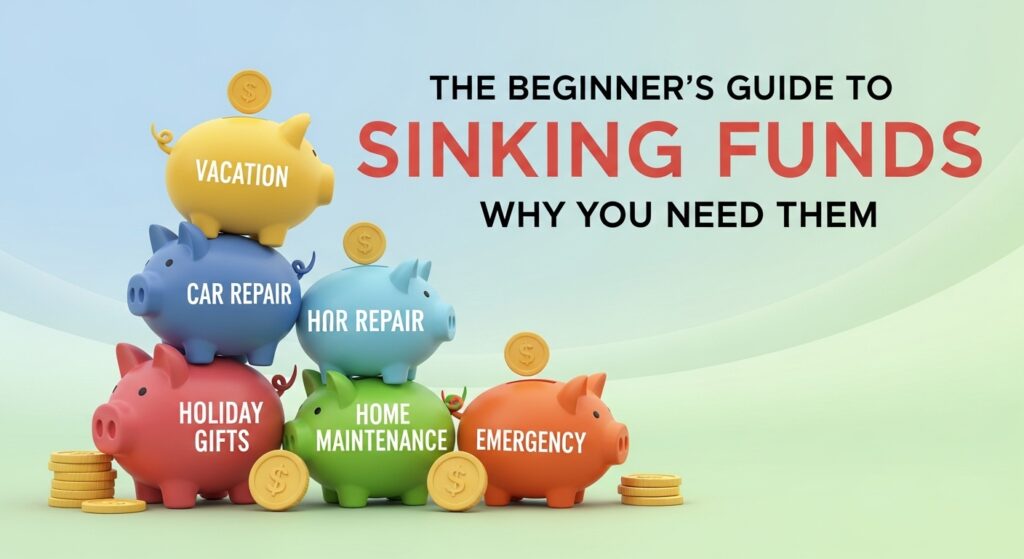
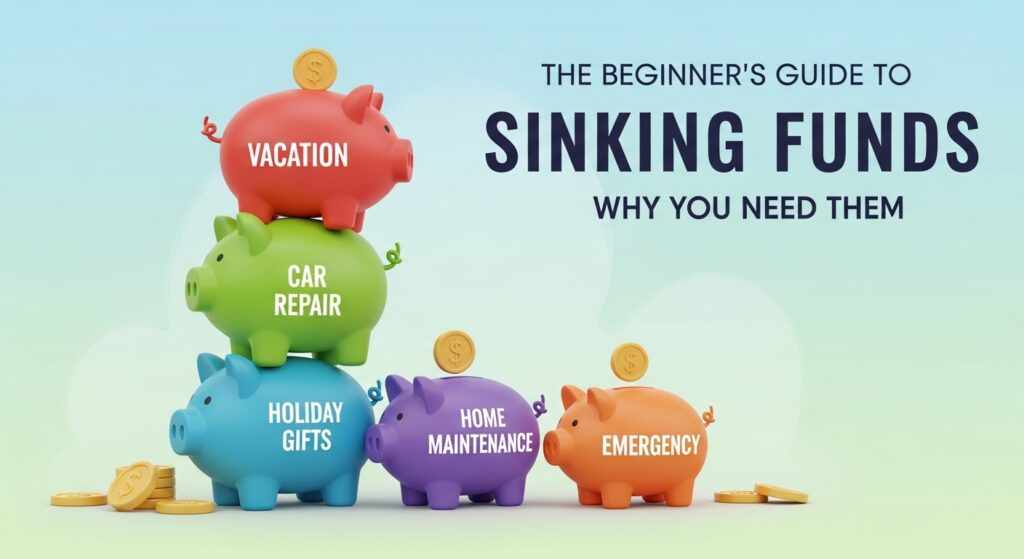
1. Holidays and Gifts
Christmas, Hanukkah, birthdays, and weddings happen every year. Estimate your total annual gift spending and divide by 12.
2. Car Maintenance and Repairs
Tires, oil changes, and the inevitable “check engine” light. Even if your car is new, it will need maintenance eventually.
3. Home Maintenance
The “1% Rule” suggests saving 1% of your home’s value annually for repairs. This covers everything from a leaky faucet to a new HVAC system.
4. Annual Subscriptions and Memberships
Amazon Prime, Costco, professional licenses, or that annual gym membership. These small “pings” can add up if they all hit in the same month.
5. Property Taxes and Insurance
If these aren’t included in your mortgage escrow, they are prime candidates for a sinking fund.
6. Travel and Vacations
Don’t put your summer vacation on a credit card. Save for the flights, hotel, and spending money throughout the year.
7. Medical and Dental Out-of-Pocket
Even with insurance, you likely have deductibles, co-pays, or vision/dental costs that aren’t fully covered.
8. Pet Care
Annual vet visits, vaccinations, and the “emergency” vet fund for when Fido eats something he shouldn’t.
9. Technology Upgrades
Phones, laptops, and tablets don’t last forever. If you know you’ll need a new phone in two years, start saving $30 a month now.
10. Self-Care and “Treat Yo’ Self”
Want a spa day or a high-end wardrobe refresh? Creating a sinking fund for “wants” ensures you can enjoy them without sabotaging your “needs.”
How to Calculate Your Sinking Fund Needs {#calculations}
Calculating your sinking fund needs is a simple three-step process. Once you have your categories, you need to determine how much to save each month.
Step 1: Determine the Total Cost
Estimate how much the expense will be. For some things, like car insurance, you know the exact amount. For others, like home maintenance, you’ll need to make an educated guess.
Step 2: Determine the Deadline
When will you need the money? If it’s for Christmas, your deadline is December. If it’s for a new car in three years, your deadline is 36 months away.
Step 3: Divide and Conquer
Divide the total cost by the number of months until the deadline. This is your monthly sinking fund contribution.
Example: The “New Laptop” Sinking Fund
- Total Cost: $1,200
- Deadline: 12 months from now
- Monthly Contribution: $1,200 / 12 = $100 per month
Where to Keep Your Sinking Funds {#where-to-keep}
One of the most common questions beginners ask is: “Where do I actually put this money?” You have a few options, depending on your personal preference and how your bank is set up.
1. High-Yield Savings Accounts (HYSA)
This is the gold standard for sinking funds. An HYSA keeps your money safe, liquid, and earning a bit of interest. In 2026, many HYSAs offer competitive rates that can help your sinking funds grow even faster.
2. “Buckets” or “Vaults” within One Account
Many modern banks (like Ally, SoFi, or Marcus) allow you to create “buckets” or “vaults” within a single savings account. This is the easiest way to manage multiple sinking funds without opening a dozen different accounts. You can see exactly how much is in your “Car Maintenance” bucket versus your “Vacation” bucket, all in one place.
3. Separate Savings Accounts
If your bank doesn’t offer buckets, you can open separate savings accounts for each major sinking fund. This can be a bit more work to manage, but it provides a clear physical separation of your money.
4. Cash Envelopes
For some people, physical cash is the best way to save. You can use the “envelope system” for smaller sinking funds like “Birthdays” or “Pet Care.” However, keep in mind that cash doesn’t earn interest and can be lost or stolen.
Step-by-Step: How to Start Your First Sinking Fund {#how-to-start}
Ready to take the plunge? Here is a step-by-step guide to starting your first sinking fund today.
Step 1: Pick One Category
Don’t try to start ten sinking funds at once. Pick the one that causes you the most stress. For many people, this is “Holidays” or “Car Repairs.”
Step 2: Set Your Goal and Deadline
Determine how much you need and when you need it. Be realistic.
Step 3: Open Your Account or Bucket
Set up the place where the money will live. If you’re using an HYSA, make sure it’s linked to your checking account for easy transfers.
Step 4: Automate Your Savings
This is the most important step. Set up an automatic transfer from your checking account to your sinking fund every payday. If you don’t see the money, you won’t miss it.
Step 5: Spend with Confidence
When the time comes to use the money, do it! That’s what it’s there for. Transfer the money back to your checking account and pay the bill or make the purchase.
Common Mistakes to Avoid {#mistakes}
Even with the best intentions, it’s easy to make mistakes when starting out with sinking funds. Here are a few to watch out for.
1. Starting Too Many at Once
It’s tempting to want a sinking fund for everything, but this can quickly lead to “budget fatigue.” Start with 2-3 essential categories and add more as you get comfortable.
2. Forgetting to Re-evaluate
Your life and your expenses will change. Make sure to review your sinking funds at least once a year to ensure your goals and contributions are still accurate.
3. “Borrowing” from Your Sinking Funds
It can be tempting to “borrow” money from your “Vacation” fund to pay for a night out. Resist the urge! Sinking funds only work if you respect the “buckets” you’ve created.
4. Not Automating
If you have to manually transfer the money every month, you’re much more likely to skip a month. Automation is the key to consistency.
Frequently Asked Questions (FAQs) {#faqs}
1. Is a sinking fund the same as a savings account?
A sinking fund is a strategy for saving, while a savings account is a place to keep the money. You can use a savings account to hold your sinking funds.
2. How many sinking funds should I have?
There is no “right” number, but most people find that 5-10 categories cover their major needs without becoming overwhelming.
3. What if I can’t afford to fund all my sinking funds?
Prioritize! Start with the “needs” (like car insurance and home repairs) before the “wants” (like vacations and new tech). Even saving $10 a month is better than nothing.
4. Should I use a sinking fund for my emergency fund?
No. Your emergency fund should be its own separate “bucket” with its own rules. Sinking funds are for planned expenses, while an emergency fund is for the unplanned.
Conclusion: Your Path to Financial Peace {#conclusion}
Sinking funds are more than just a budgeting trick; they are a fundamental shift in how you relate to your money. By planning for the “unexpected” and breaking down large goals into manageable monthly habits, you are taking control of your financial future.
In 2026, with the help of modern banking tools and a bit of discipline, anyone can start using sinking funds to eliminate financial stress and achieve their goals. So, what are you waiting for? Pick your first category, set your goal, and start “sinking” that money today. Your future self will thank you.
Quick Reference: Sinking Fund Worksheet
| Category | Total Goal | Deadline (Months) | Monthly Contribution |
|---|---|---|---|
| Holidays | $1,200 | 12 | $100 |
| Car Repairs | $600 | 6 | $100 |
| Vacation | $2,400 | 12 | $200 |
| Home Maintenance | $1,000 | 10 | $100 |
| Annual Subs | $240 | 12 | $20 |
Final Thoughts for 2026 {#final-thoughts-2026}
As we move through 2026, the importance of financial resilience has never been clearer. Sinking funds are a key part of that resilience. They allow you to weather the “storms” of life with a sense of calm and confidence. Whether you’re saving for a new home, a dream vacation, or just the peace of mind that comes with knowing your bills are covered, sinking funds are the tool that will get you there.
Happy saving!