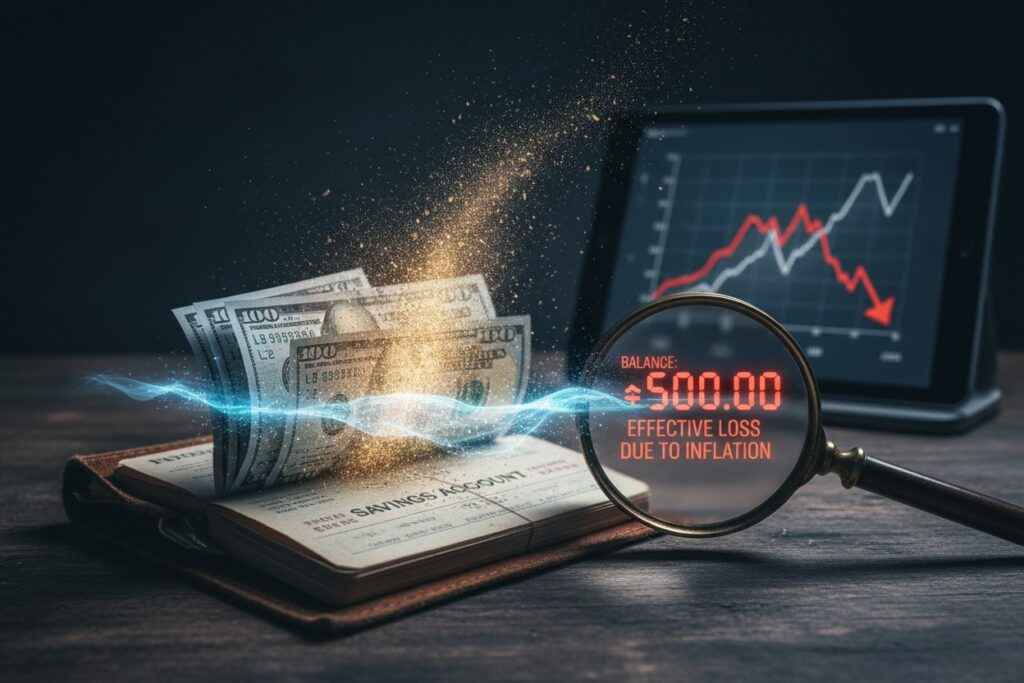
Your Traditional Savings Account : In March 2026, many savers are celebrating a return to “stability” as inflation cools. But there is a silent predator lurking in your bank account. While your balance might look like it’s growing, the real value of your money—what it can actually buy—is likely shrinking every single day.
If you are keeping your emergency fund or long-term savings in a traditional brick-and-mortar bank, you aren’t just saving money; you are effectively paying a “wealth tax” to your bank. Here is the data-driven reality of the 2026 economy and why your traditional savings account is a losing game.
Why Your Traditional Savings Account is Actually Losing You Money
1. The Math of “Negative Real Returns”
To understand why your money is disappearing, you have to look at the gap between Interest Rates and Inflation. In financial terms, this is called your Real Rate of Return.
As of March 2026, the economic numbers tell a grim story for traditional savers:
- Traditional Savings Rate: The national average for big banks (like Chase, Wells Fargo, or Bank of America) is currently stuck at 0.39% APY. Many accounts still pay as little as 0.01%.
- The Inflation Rate: According to the latest February 2026 flash estimate, inflation is currently holding steady at 2.4%.
The Calculation:
$$0.39\% \text{ (Interest)} – 2.4\% \text{ (Inflation)} = -2.01\% \text{ (Net Loss)}$$
This means for every $10,000 you leave in a traditional account, you are losing approximately $201 in purchasing power every year. Your bank balance stays the same, but your ability to buy groceries, fuel, or housing decreases.
2. The “Invisible Tax” of Purchasing Power
Inflation doesn’t take dollars out of your wallet; it takes the value out of the dollar. This is often called the “Invisible Tax.”
In March 2026, prices for services—like healthcare, insurance, and dining out—remain “sticky” and are rising faster than the general inflation rate. If your money is earning 0.39% while the cost of a doctor’s visit or a car repair rises by 4%, you are falling behind.
The 2026 Reality Check: If you put $1,000 in a traditional savings account today, in five years, that same $1,000 will likely only buy what $880 buys today. You haven’t spent a dime, yet you’ve “lost” $120.
3. Why Big Banks Pay So Little (The “Loyalty Trap”)
You might wonder: If online banks are offering 4%, why is my big bank still at 0.01%? The answer is Inertia. Major traditional banks have “sticky” customers. They know that most people find it a “hassle” to switch banks, so they don’t feel the need to compete on interest rates.
- The Spread: Big banks take your money (paying you 0.39%) and lend it back to other customers via credit cards or personal loans at 15% to 25%.
- The Profit: They are essentially using your “lazy” money to generate massive profit margins while providing you with a return that doesn’t even beat a moderate inflation rate.
4. The 2026 Savings Landscape: Where the Money is Hiding
The good news is that you don’t have to accept a negative return. The financial world in 2026 has bifurcated into “Savers who know” and “Savers who don’t.”
| Account Type | Average Rate (March 2026) | Real Return (After 2.4% Inflation) |
| Traditional Savings | 0.39% | -2.01% (Losing) |
| High-Yield Savings (HYSA) | 4.09% | +1.69% (Gaining) |
| 1-Year CD | 3.40% | +1.00% (Gaining) |
| Money Market Account | 3.75% | +1.35% (Gaining) |
High-Yield Savings Accounts (HYSA)
Digital-first banks (like Openbank, Vio, or Peak Bank) are currently the champions of 2026. Because they don’t have the overhead of thousands of physical branches, they pass those savings on to you. A rate of 4.09% isn’t just “better”—it’s the difference between growing your wealth and watching it evaporate.
5. Strategies to Stop the Leak
If you’re realized your traditional account is a “leaky bucket,” here is your 3-step fix for 2026:
A. The “Emergency Switch”
Keep your checking account at your big bank for convenience, but move your Emergency Fund to an online HYSA. Most transfers now take less than 24 hours, so your money remains liquid but actually earns its keep.
B. “Ladder” Your Savings
If you are worried that interest rates will drop further in the summer of 2026, consider a CD Ladder. By putting a portion of your money into a 6-month, 12-month, and 18-month CD, you “lock in” today’s higher rates even if the market cools later this year.
C. Automate the Growth
Set up an automatic “sweep” from your traditional checking to your high-yield account the day after your paycheck hits. If you don’t see the money in your low-interest account, you won’t leave it there to lose value.
Conclusion: Don’t Be a “Lazy” Saver
In 2026, financial security isn’t just about how much you work; it’s about how hard your money works for you. Leaving your hard-earned cash in a traditional savings account is a quiet, slow-motion disaster for your net worth.
By making the switch to a high-yield environment, you turn a -2.01% loss into a +1.69% gain. In a world of rising costs, that is the most important “raise” you can give yourself.